
From breakdowns to untaxed vehicles, crimes, abandoned cars and obstructions, every year police forces across the UK remove thousands of vehicles from our roads.
There are multiple reasons why the police can take a vehicle and the outcomes of this seizure can also vary; some vehicles are returned to their owners, while others are sold at auction and others are scrapped.
We wanted to find out what parts of the country see the most car seizures and what are some of the most common reasons that police take this step?
To find out, we conducted a Freedom of Information request to each police force in the UK for the number of impounded vehicles in 2022, 2023 and 2024.
Regions with the highest number of vehicle seizures

West Midlands saw the highest number of vehicle seizures with an impressive 24,197 vehicles possessed by the police force in 2024.
While 65% of these vehicles were returned to their owners, over a third (34%) of these vehicles were either destroyed and a further 317 vehicles were sold at auction. There was an increase of 994 vehicles impounded in comparison to the previous year.
According to plumplot, the West Midlands has a crime rate of 40.8 crimes per 1,000 people, which is 117% of the national average. In fact, 22% of their seized vehicles were reported as stolen vehicles in 2024.
The second region with the highest number of seized vehicles is Greater Manchester, with 20,832 vehicle seizures in 2024. 36% of these vehicles were either destroyed or sold at auction, and 63% were returned to their owners.
Greater Manchester police auctioned the most vehicles in 2024 with 3,743 vehicles, followed by Wiltshire Police with 2,417 vehicles and Thames Valley Police with 1,918 vehicles auctioned.
There was a 185% increase in the number of vehicles auctioned in Greater Manchester, with 2,431 vehicles auctioned in 2024, compared to 1,312 in 2023.
West Yorkshire ranked in third, with 20,770 seized vehicles. Vehicle crime accounted for 5.7% of the total crime statistics in West Yorkshire.
The most common reasons for vehicle seizures

The police can seize vehicles for a number of reasons, whether it has been used in a crime, abandoned, considered a nuisance or risk, or is untaxed.
Our study revealed that the most common reason for a vehicle to be impounded was due to the driver having no insurance or driving licence, which means the vehicle does not abide by Section 165 of the Road Traffic Act 1988.

You are required by law to hold a full, valid driving licence, with the only exception being learner drivers who hold a provisional licence and must be accompanied by a full licence holder. Additionally, under motoring law, anyone using a vehicle on the road or another public place must have valid insurance against third party risks. This includes vehicles which are merely parked on public roads and not being driven.
Drivers who don’t abide by these laws can face fines, driving bans and in the case here, see their vehicles seized.
In 2024, 51,616 vehicles were impounded for having no insurance or licence, compared to 55,617 in 2023. The highest volume of these cases were in Greater Manchester with 12,146 vehicles seized in the previous 12 month period.
The second most common reason is road traffic collisions with 36,739 incidents leading to vehicle seizures, a decrease of 11,703 incidents from 2023. Bedfordshire, Hertfordshire and Cambridgeshire combined constabularies reported the highest number of incidents with 5,109 cars possessed by the police in that period.
In these events, the cars are typically seized because they’re no longer in a road-worthy state following the accident, or are being kept as evidence by the police. An additional 3,634 vehicles were seized in this period due to life altering accidents.
Over 21,000 cars were impounded by the police in 2024 after being found to have been stolen. When the police find a vehicle that’s been reported lost or stolen, they treat all vehicles as abandoned vehicles and move it to a police pound. This is done to protect the vehicle from further damage, ensuring it isn’t an obstruction or danger to other road users before contacting the registered vehicle owner in the hopes of returning it, if it’s in a roadworthy condition.
West Midlands, Greater Manchester and South Yorkshire had the highest number of stolen vehicles in the UK.
Concerned your unused car could be considered abandoned?
An unused vehicle isn’t always considered abandoned, there is a certain criteria that classifies a car as abandoned by the letter of the law. The authorities typically run through the following checklist to see whether the vehicle is abandoned or not.
- The car has no registered keeper on the DVLA database, and is untaxed
- The car has been stationary for a significant period
- The car is significantly damaged, worn out or not fit for use on the road (including things like flat tyres or broken windows)
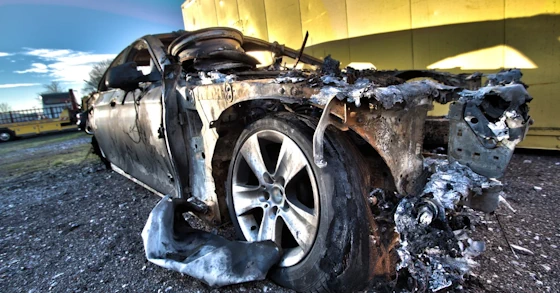
- The car has been set on fire
- The car is missing a number plate
As you can see, some of these are more extreme than others. It only needs one of these circumstances to be true of any motor for it to be considered abandoned.
If you have an unused vehicle that you wish to abandon, National Scrap Car will track down the highest offers for your motor from professional scrap and salvage specialists in your local area, wherever you are in the UK. We even let you choose a date and time for it to be collected from you at no extra cost!
Methodology
We contacted each police force in the UK via a Freedom of Information request, asking for the number of vehicles that they seized throughout 2024, 2023 and 2024, what happened to those vehicles, as well as their reasons for doing so.
Please note that each police force used slightly different terminology to categorise their reasons for seizure, therefore there may be some overlap between categories.
30 out of 45 police forces in England, Scotland, Northern Ireland and Wales replied to our Freedom of Information request with data on vehicle seizures in 2024, and 26 responded with data on seizures in 2022 and 2023.